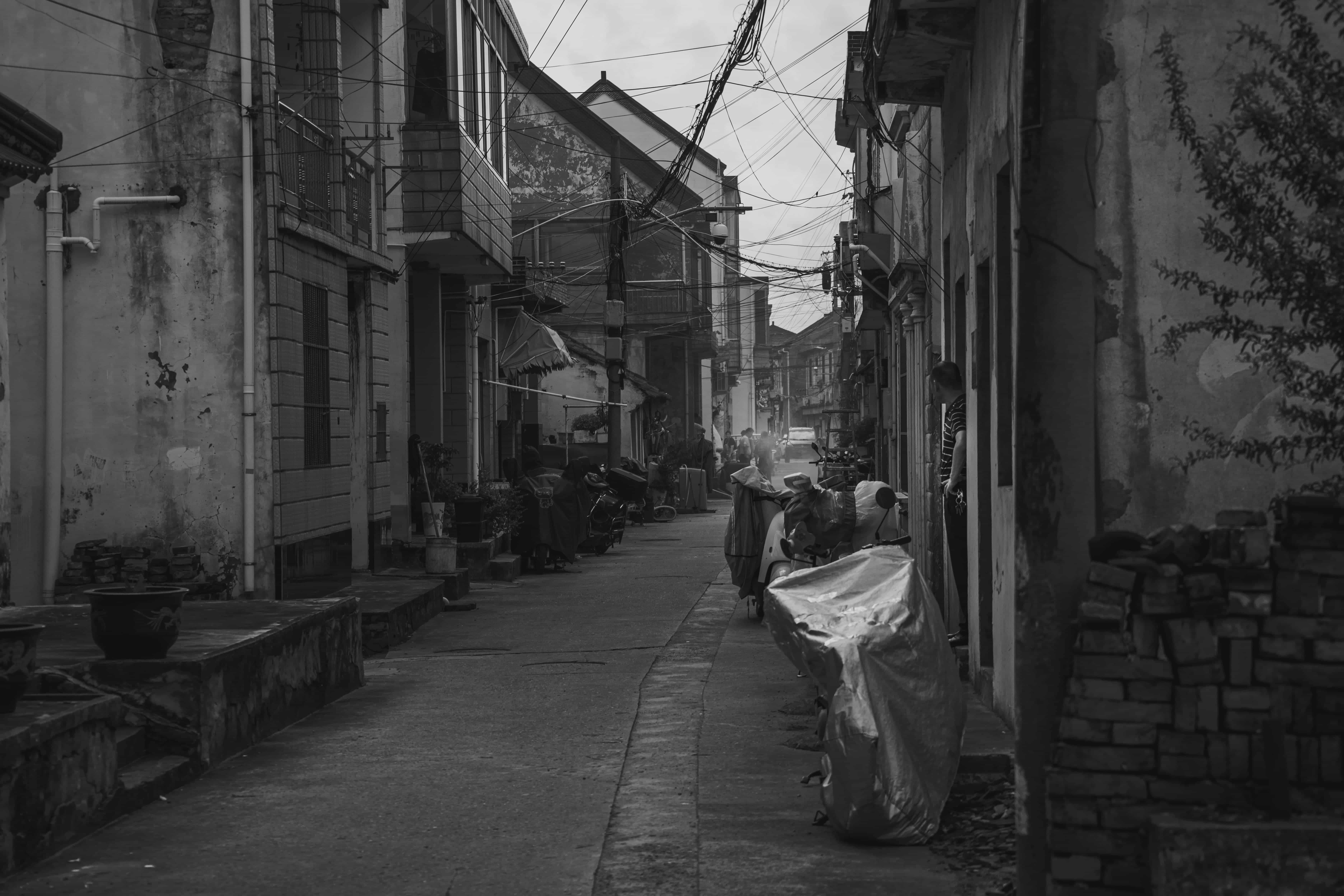

Some of the most important things in a nostalgic neighborhood are not monumental. They are not landmark gates, protected façades, or famous squares. They are shirts drying from a balcony rail, a stool placed half inside a doorway, slippers lined near a threshold, herbs in plastic buckets, a folding chair under an awning, a mop leaning against old tile, a curtain moving in a screened window, a grandmother sorting greens while watching the lane, or a child doing homework at a table close enough to hear the street.
These details rarely headline preservation campaigns, yet they are essential to what makes retro communities feel inhabited. They reveal a distinctive mode of domestic urbanism in which home does not stop abruptly at the wall. Instead, daily life extends outward in controlled, visible, semi-public ways. The result is a neighborhood full of thresholds: physical edges where private routine and public street life overlap.
In many old districts, this threshold life creates the social texture people remember most vividly. It is where residents greet one another, monitor children, cool down in the evening, repair small objects, sort groceries, dry laundry, water plants, and maintain the low-level visibility that helps a street feel safe. Laundry above, shoes below, and open doors in between are not signs of disorder. They are evidence of a living settlement still organized around human rhythm rather than sealed isolation.
This article explores why balconies, laundry, stoops, doorways, windows, and other threshold spaces matter so much in nostalgic neighborhoods. It considers their social, climatic, and cultural functions, the way they support belonging and surveillance without formal policing, and the risks posed when redevelopment or aesthetic cleanup erases them.
What Threshold Life Means
Threshold life refers to all the activities that happen at the edge between home and street. It includes balconies, stoops, porches, arcades, doorways, window seats, front steps, shared corridors, courtyard edges, recessed shopfronts, and any other in-between space that allows residents to participate in public life without fully leaving domestic territory.
These spaces are valuable because they lower the cost of social contact. A resident does not need to plan an outing in order to become visible. They can simply sit near the entrance, shake out a cloth, tend plants, peel fruit, fold laundry, or speak from a balcony. Others do the same. Small exchanges begin. Information circulates. The neighborhood watches itself in a dispersed and ordinary way.
In highly privatized urban environments, the gap between indoors and outdoors is often too sharp. One is inside a sealed dwelling or fully out in public. Threshold life weakens because the middle ground disappears. Old neighborhoods tend to preserve that middle ground, and with it a more flexible social order.
Threshold spaces also support emotional ease. They allow residents to join the street gradually. An elderly person who no longer walks far can still participate from a chair at the doorway. A caregiver can supervise a child from the entrance. A shopkeeper can rest just inside while remaining available to customers. A teenager can study beside an open window while staying linked to neighborhood life. The district becomes socially thick because participation has many levels.
Why Laundry Is More Than Laundry
Hanging laundry is one of the most recognizable features of nostalgic urban neighborhoods, yet it is often misunderstood. Outsiders may see laundry lines as picturesque clutter or proof of old-fashioned living. Residents usually understand something more practical and more revealing.
Laundry shows how households negotiate space, weather, privacy, and visibility. In dense older districts, drying clothes on balconies, courtyards, windows, rooftops, rear lanes, or shared lines is an adaptive response to compact housing and limited indoor utility space. But it also contributes to the identity of the street. Fabric gives the neighborhood motion, color, and evidence of everyday care.
A line of children’s uniforms, work shirts, aprons, bed linen, and towels is a record of household life. It suggests occupations, routines, family size, season, and weather. Residents unconsciously read these signals. They know when rain is coming because laundry disappears early. They know the lane has awakened because cloth begins to appear overhead. They know a holiday is near because better garments are aired out.
Laundry also reveals the climatic intelligence of old neighborhoods. People hang different fabrics in different places depending on sun, wind, privacy, and humidity. Balconies capture airflow. Courtyards protect delicate items. Roof edges maximize sun. Retractable lines adapt to rain. What seems informal is often highly knowledgeable.
In this sense, laundry is part of the environmental choreography of the district. It turns architecture into a working system. Balconies, rails, courtyards, poles, and windows are not merely visual features; they are domestic infrastructure.
Balconies as Social Devices, Not Just Design Elements
Developers often advertise balconies as lifestyle amenities, but in old neighborhoods balconies function less as luxury appendages and more as social devices. They are places to observe, rest, dry clothes, cool food, store plants, shake rugs, call to neighbors, monitor weather, and participate in the street without descending into it.
A balcony extends the house outward and upward. It gives residents a semi-private perch from which to register the neighborhood’s rhythm. Someone watering plants from above sees who has opened shop, whether schoolchildren have passed, whether rain is approaching, or whether a delivery has arrived. Balconies create a layered public life in vertical space.
They also soften density. In compact districts where indoor rooms may be small, a balcony provides relief and additional use. Even a narrow one can hold a stool, basin, drying rack, or potted herb garden. This extra surface area matters disproportionately in older housing stock.
Importantly, balconies support low-intensity familiarity. Residents may not know one another deeply, but repeated balcony-to-street and balcony-to-balcony visibility builds recognition. That recognition strengthens mutual care. People notice if a shutter stays closed too long, if an elderly neighbor has not appeared, or if a storm requires quick help securing loose items.
When balcony life disappears—because facades are enclosed, strict visual regulations ban drying, or housing turns into short-stay accommodation—the street often loses some of its domestic presence. It looks cleaner in a narrow sense but feels less inhabited.
The Open Door and the Half-Open Door
Doorways in historic neighborhoods do more than grant access. They communicate social availability. An open door can mean air circulation, work in progress, family activity, or welcome. A half-open door may indicate watchfulness, caution, or simply the practical need to hear the street while maintaining privacy. A stool placed just outside the door often turns the threshold into a social station.
Older residents especially use doorways as micro-public rooms. Sitting close to the entrance allows participation without exertion. One can greet passersby, receive news, supervise grandchildren, shell beans, mend clothing, or simply enjoy the air. This posture is central to the social metabolism of many nostalgic districts.
Open doors also create a particular moral environment. They make behavior more legible. People moderate themselves because life is visible. Children are indirectly supervised by many adults. Deliveries are noticed. Minor disturbances are observed early. Help is easier to request because someone is already near the edge of public space.
This kind of social visibility is not the same as intrusive surveillance. It works best when grounded in familiarity and reciprocity rather than suspicion. The threshold is effective because it invites soft attention, not constant enforcement.
Domestic Objects as Street Signals
One of the charms of old neighborhoods is the presence of domestic objects in semi-public view: brooms, buckets, stools, wash basins, folded carts, potted plants, bird cages, umbrellas, slippers, bamboo poles, watering cans, crates, fans, and small tables. These objects help organize threshold life.
They are tools of adaptation. A stool means someone may sit outside in the evening. A bucket near the entrance suggests cleaning or rain management. Plants indicate care and territorial softening. Shoes at the edge of the door show the home’s customs. A folding table signals that work, sorting, or conversation may happen there.
To an outsider, such items can look like clutter. But in many nostalgic neighborhoods they form a precise grammar of use. They show that the edge of the house is active, that people claim and maintain space, and that daily life remains close to the street.
This matters for neighborhood atmosphere. Streets lined only with blank walls, tinted glass, and coded lobbies may be visually neat, but they communicate little. Domestic objects, by contrast, suggest human scale and ongoing care. They reveal that order in an old neighborhood is often lived rather than imposed.
Climate, Comfort, and the Semi-Outdoor Home
Threshold life is not only social. It is climatic. Balconies, shaded entries, arcades, and open windows help residents regulate heat, humidity, and airflow in ways that sealed housing often cannot.
In hot weather, the threshold becomes a cooler alternative to the interior, especially in buildings with limited mechanical ventilation. People sit near open doors to catch moving air. Laundry is arranged to maximize drying while avoiding harsh sun. Plants create moisture and shade. Evening life spills outward because indoor rooms retain daytime heat.
In rainy seasons, threshold spaces help stage transitions between wet street and dry interior. Shoes are removed, umbrellas drained, mats shaken, and damp clothing aired near the entrance. A deep eave or covered stoop can transform a difficult climate moment into an ordinary routine.
During cooler months, balconies and sunny thresholds capture warmth. Residents follow the sun across the dwelling’s edges, using different zones at different hours. The neighborhood’s domestic life becomes seasonally mobile.
This environmental flexibility is a major reason old neighborhoods feel more alive at ground level. Architecture does not separate residents from weather entirely; it gives them tools to negotiate with it. Threshold spaces are the negotiation zone.
Thresholds and Informal Social Infrastructure
Modern cities often look for social infrastructure in formal institutions such as libraries, parks, schools, and community centers. Those places matter enormously. But nostalgic neighborhoods also depend on informal social infrastructure, much of which operates through thresholds.
A person sitting at a doorway becomes a source of local information. A balcony exchange becomes a welfare check. Laundry lines become indicators of household routine. A shop threshold becomes a conversation node. A child moving between home and lane gains confidence because many eyes are casually present.
These patterns are especially important for older adults, single residents, and caregivers. Threshold life reduces isolation without demanding organized participation. One does not need to join a program or attend an event. One only needs to remain at the edge of the home, where neighborhood interaction is available in small, manageable doses.
That is one reason many retro communities feel surprisingly resilient despite modest incomes or aging buildings. Their social systems are not entirely dependent on institutions. They are distributed through everyday habits embedded in space.
Why Aesthetic Cleanup Can Damage Neighborhood Life
Urban upgrading often misunderstands threshold culture. Officials, developers, or new affluent residents may interpret hanging laundry, outdoor stools, potted plants, open doors, or visible household objects as signs of backwardness, disorder, or visual inconsistency. Efforts to “clean up” the neighborhood may then prohibit drying on balconies, remove informal seating, standardize facades, close shopfronts, or replace open entrances with secure lobbies.
The result can be visually tidy but socially thin. When residents lose the ability to occupy thresholds freely, they retreat indoors. Casual encounter declines. Informal care weakens. The street becomes more controlled and less conversational.
This change is often defended in the language of modernization, but it can amount to the removal of a district’s domestic intelligence. What looked like clutter was actually a support system. What seemed untidy was often a sign that people still used space closely and confidently.
This does not mean all threshold activity should remain unregulated. Clear paths, sanitation, safety, and accessibility matter. But good policy distinguishes between harmful obstruction and life-giving occupation. It should support organized liveliness rather than eliminate visible domesticity altogether.
Gender, Labor, and the Politics of Visibility
Threshold life also reveals who performs daily labor and whose work becomes visible. Laundry, food preparation near doorways, plant care, child supervision, and small repair tasks often reflect gendered divisions of labor, especially in more traditional communities. This reality should not be romanticized uncritically.
At the same time, threshold spaces can make undervalued domestic labor legible. In sealed housing, household work disappears behind doors and becomes easy to ignore. In old neighborhoods, the act of washing, drying, mending, peeling, sweeping, and watching is partially visible. The neighborhood sees that care is work.
This visibility can create both solidarity and pressure. People may appreciate one another’s routines, but they may also feel judged by norms of tidiness or propriety. The threshold is not an innocent space. It is social, and social space always carries expectations.
Still, even this complexity helps explain why retro communities feel culturally dense. The street does not display only consumption and mobility. It displays maintenance, care, and repetition—the hidden labor of neighborhood survival.
What Visitors Notice and What Residents Understand
Visitors often photograph laundry and balconies because they appear picturesque. Residents rarely experience them that way. For locals, these features are practical systems first. They allow air, light, work, storage, exchange, and social contact. Their beauty comes from use, not from curation.
This difference matters. When nostalgic neighborhoods are consumed primarily as scenery, threshold life may be tolerated only as long as it looks charming. But real domestic life is not always charming. It can be messy, improvised, weather-beaten, and repetitive. Preserving the reality of old neighborhoods means preserving ordinary use, not just decorative traces of it.
A balcony with perfectly staged plants but no drying rack, no stool, no bucket, and no signs of routine may still look attractive. Yet it does not necessarily sustain neighborhood life. The same is true for restored facades behind which nobody lives permanently. The threshold becomes an image rather than a function.
The healthiest retro communities resist that emptiness. They remain places where people still use edges of space to conduct the small tasks that bind life together.
How to Support Threshold Life Without Freezing It
Preserving threshold culture does not require turning neighborhoods into museums of old habits. It means protecting the conditions that allow residents to keep adapting space in practical, visible ways.
Housing policy should support long-term residents so that domestic routine remains embedded in the district. Renovation guidelines should allow operable balconies, shaded entries, and practical drying solutions rather than enforcing facade purity at the expense of livability. Streets should be kept walkable and slow enough that doorstep life feels safe. Benches, trees, and pocket public space can extend threshold sociability into the street without replacing it.
Property managers and local governments should distinguish between genuine hazards and harmless forms of occupation. A small cluster of plants, a chair at the doorway, or a drying rack used responsibly should not be treated the same as dangerous obstruction.
Preservation groups can also broaden the way they document heritage. Instead of focusing only on architectural details, they can record how balconies are used, how laundry circulates through the district, how doorways function as seating rooms, and how threshold objects shape the street. Everyday domestic practice is part of cultural heritage too.
Why the Life at the Edge Matters
Old neighborhoods endure in memory because they are full of edges that still work. The balcony is not just a balcony. The doorway is not just a doorway. The laundry line is not just a utility. Each is part of a social and climatic system that lets dense urban living remain intimate, adaptive, and visible.
Threshold life teaches a larger urban lesson. People do not thrive only in large formal public spaces or fully private interiors. They thrive in intermediate zones where presence can be partial, repeated, and low-pressure. These are the spaces where a city learns to feel like a neighborhood.
That is why retro communities often leave such a strong impression. Their identity is not created only by architecture but by the domestic theater played out at the edges of buildings every day. Shirts move in the wind. Doors open and close. A stool appears at dusk. Plants are watered. Someone calls down from above. Someone answers from the lane.
In those ordinary acts, the neighborhood proves that home can extend outward without losing dignity, and that public life can remain warm when it is built from small gestures rather than grand design. If cities want more humane streets, they should pay closer attention to what happens where the house meets the world.
SEO Keywords and Search Intent
- balcony life in old neighborhoods
- why laundry lines matter in historic districts
- threshold life in nostalgic communities
- open door culture in retro neighborhoods
- how old neighborhoods create community through doorways
- balcony laundry urban heritage
- everyday domestic life in historic districts
- why old streets feel lived in
- semi-public space in traditional neighborhoods
- stoops balconies and neighborhood identity
- preserving threshold culture in old communities
- domestic urbanism in walkable neighborhoods
- laundry and social life in dense historic areas
- human-scale living in retro districts
- how thresholds create safer friendlier streets